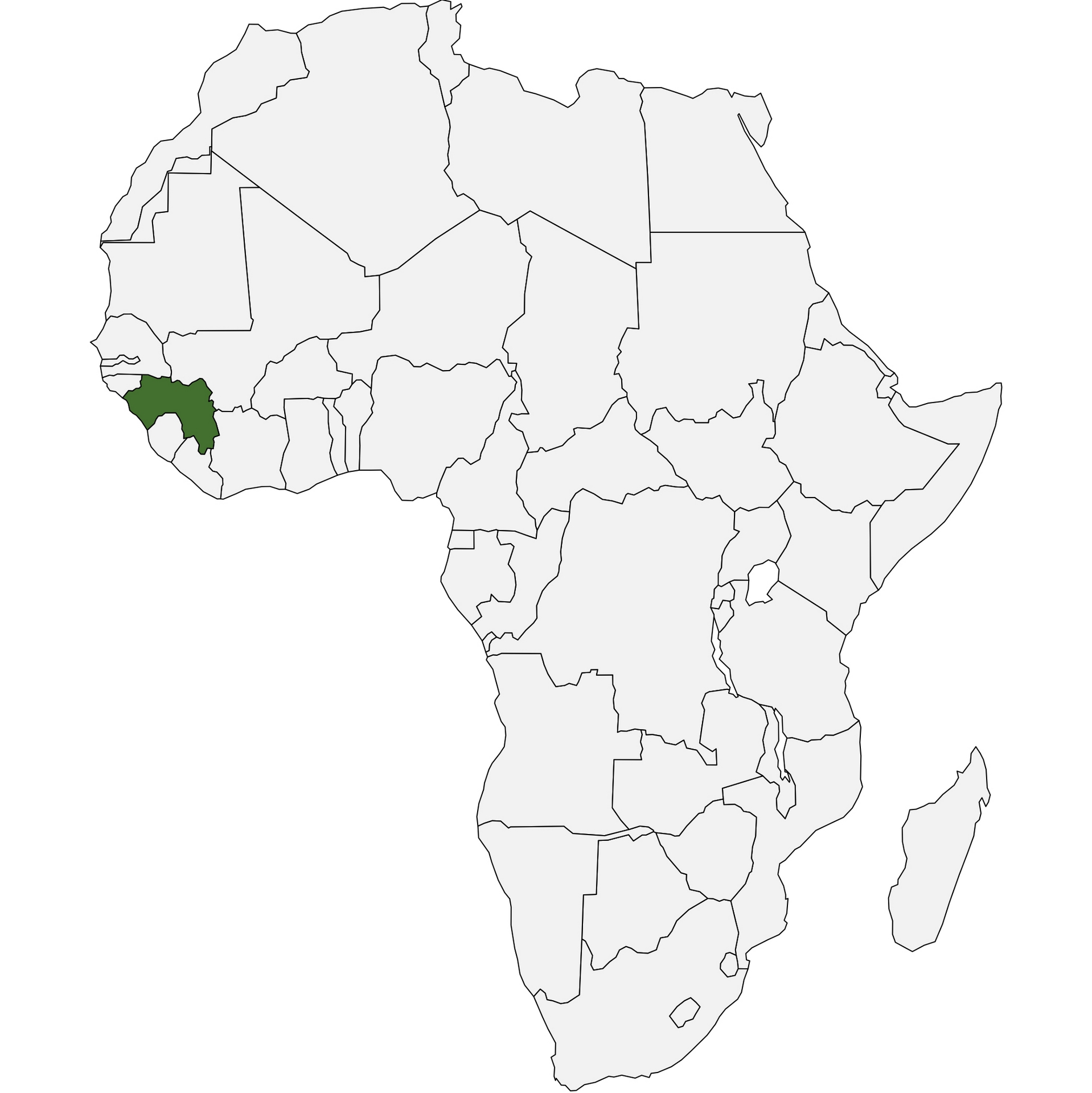
Guinea is on the west coast of the
continent of Africa.
It is roughly the same size as the
American state of Colorado,
and is home to 15 million people.

The Guinee maritime region is filled with mangrove swamps and alluvial plains that support palm trees and coconuts.
Northeast of Maritime is Middle Guinea (Moyenne Guinee). This mountainous region has cool temperatures, allowing for the cultivation of potatoes and strawberries.
To the east of Middle Guinea is Upper Guinea (Haute Guinee), a savanna region with plains and river valleys. The Milo and Niger rivers are important for fishing, irrigation, and transportation.
The southernmost region is the Forest Region (Guinee Forestiere). Rainfall is heavy, and the area is dense with rain forests with mahogany, teak, and ebony trees. Agricultural exploitation and the demand for tropical hardwoods have increased the rate of deforestation. Many valuable resources are found, including gold, diamonds, and iron ore.


Economy
The national export economy is primarily based on bauxite, with lesser contributions from iron ore, gold, and diamonds. Due to an extremely low total annual income per person of $1,730 (GNI), a majority (80%) of citizens attempt to meet their minimum daily nutritional needs by farming.
Most people farm out of necessity, and not out of a passion for the vocation.
Despite challenges to modernize their economy and culture, Guineans have used their community strength to form economic cooperatives. These cooperatives are called groupements and commonly revolve around agriculture activities for both men and women. The strength in these groupements lies in their ability to pool the work efforts of several participants in order to more quickly reach a collective goal (purchasing an agricultural tool or processing machine).
Most boys and girls and receive a free basic primary education from the state with minimal out of pocket cost from the parent. However, due to repeated mismanagement and poor educational leadership by former federal and regional governments, more than half of children never finish 6th grade. A further winnowing of the educated populace occurs during the culmination of the French Baccalauréat exams, marking the end of secondary school.
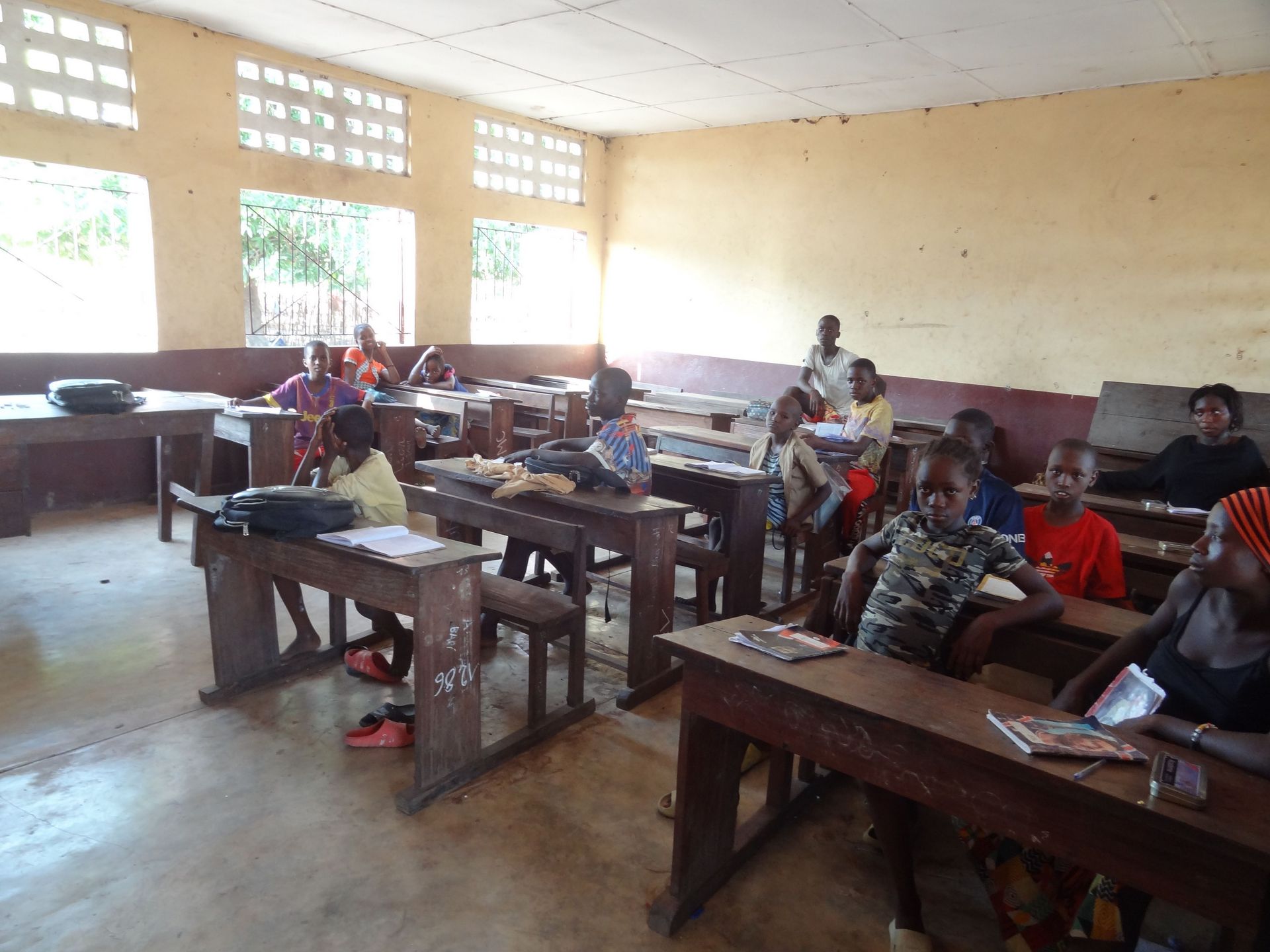
Though there are apprenticeship programs that teach youth and young adults metalworking, woodworking, and automobile repair, there is little emphasis on training for STEM subjects (science, technology, engineering and math) that have become the foundation of advanced civilizations. Technology has permeated most parts of Guinean society, but because of the high cost, it remains inaccessible to the Guinean people. In addition, the government has failed to capitalize on the economizing aspects that technology has on society. Many records are still kept on paper, and there are few financial controls to limit fraud and corruption.
Culture - click for more information
Current Realities of Life
in West Africa
1. Illiteracy is common. Though everyone speaks a local language, most can neither read nor write in their local language.
2. Most people are highly skilled and proficient in activities that trap them in poverty. They have maximized the outcomes that they can achieve with the techniques that they have already mastered.
Walking faster when they plant corn by hand is not going to appreciably change their harvest.
3. Contemporary skill levels and management competence of the local populations are low. Most Guinean have never had a “modern” job (Defined responsibilities, consistent salary, hourly wage, or wage per output.)
4. Corruption, graft, and nepotism are very prevalent in Guinea.
5. Public goods are common but ill-maintained, or influenced by graft and corruption. Beyond basic necessities, private property is limited to basic technology (cell phone, sound speakers, simple solar operated devices), and simple farm equipment (plow, cultivator, donkey cart). Richer families may be able to afford a bicycle or a motorcycle.
Private property is not shared beyond the family network. Land holdings are private, but are loosely enforced through extra-legal means. Because this property is held outside the legal system, it is unavailable to be used as collateral for a loan.
6. The judicial system is weak and rife with corruption. Verbal contracts are nearly meaningless. Written contracts are rare, due to the prevalence of illiteracy of the population.
7. Familial connections are so corrupted by nepotism and tribal values that financial profits gained through an individual’s industriousness and discipline must always be shared with the extended family regardless of the families’ contribution to the earned profits. These tribal values are reinforced by innate human biology that gives preference to one’s own gene pool, helping to guarantee the survival of the human species, or at least one small branch of the human species.
8. There are few traditions of saving and planning in most communities. Because the times when a family does have extra money are so infrequent, most families do not regularly save nor do they develop good planning skills and strategies.
Saving options are limited to mobile banking, where cash reserves are linked to an individual cell phone number, and the ownership of livestock. Though livestock does offer the owner an opportunity to grow his or her investment when the animal reproduces, theft and poor animal husbandry practices increase the risk of investment loss. In addition, the time needed to manage livestock reduces the productivity of the family, especially time needed for the children to reinforce educational studies.
9. Most entrepreneurial activity is severely risk averse.
People misjudge the level of risk in potential entrepreneurial endeavors. Due to an extreme aversion to risk, most entrepreneurs more willingly pursue income generating activities that that others are pursuing rather investing efforts in meeting demand for the products and services of the future.
Entrepreneurs choose areas with already established competition than investing the effort in new product or service development.
10. Most agriculture activities are focused on the production side of raw agricultural commodities. Little investment occurs in developing the demand side of food production, most notably in value added and processed food production.
11. As a family’s income rises, their fixed expenses also tend to rise (an additional wife, more children.) Thus, even families not living hand to mouth struggle to accumulate savings.
12. People have a surplus of time. This is primarily due to a long history of a lack of economic opportunities in the region.
People place a very low value on their time.
13. The expectations of a Guinean are often different than those of the first world. For example, a child may urinate in his or her pants, and their clothing will be allowed to dry and changed only in the evening when the child takes a bath. Second, a child is allowed to play with a syringe and hypodermic needle as if they were toys.
 It is only through acknowledging and understanding the current realities within Guinea that we can design effective methods and procedures to create economic success for farmers.